Understanding the Structure of a Planeswalker and Creature Card Using Liliana of the Veil
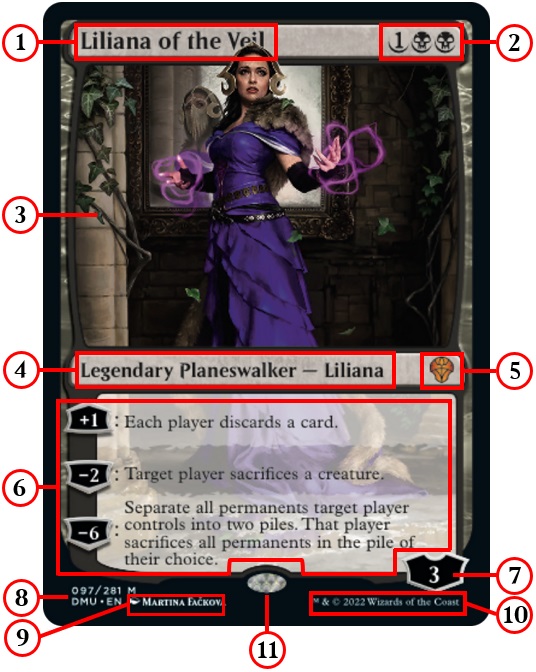
Magic: The Gathering cards might seem complex at first glance, but each part of the card serves a specific function. In this guide, we will walk through each key component of a Magic card using "Liliana of the Veil" as our reference point. We will also explain how each of these components may differ if the card were a creature, such as "Serra Angel."
1. Card Name
The top-left part of every Magic card contains its name, in this case: Liliana of the Veil. This is the official name of the card, which is essential for gameplay and deck construction. The name determines uniqueness; for example, you can only have one legendary permanent of the same name on the battlefield unless a rule or ability allows otherwise. This is particularly important with legendary planeswalkers and legendary creatures. With creatures, the name follows the same structure and also plays a key role in synergy with cards that reference specific names or types.
2. Mana Cost
To the top-right of the card is the mana cost, displayed as a combination of symbols. For Liliana, the cost is 1BB, which means one generic mana and two black mana are required to cast her. This dictates not only how early you can play the card in a game, but also what colors your deck must produce.
Understanding the different types of mana is crucial:
White (W): Represented by a sun symbol and usually associated with order, protection, and healing.
Blue (U): Represented by a water drop, symbolizing knowledge, manipulation, and illusion.
Black (B): Represented by a skull, standing for death, sacrifice, and ambition.
Red (R): Represented by a flame, indicating chaos, speed, and destruction.
Green (G): Represented by a tree, focused on growth, nature, and strength.
Colorless (◇): Used for certain spells and abilities, especially in artifact-heavy or Eldrazi-themed decks.
In addition, there are special mana symbols:
Hybrid Mana (e.g., {W/U}): Can be paid with either color shown.
Phyrexian Mana (e.g., {B/P}): Can be paid with either the specified mana or 2 life.
Snow Mana (❄): Requires mana from a snow permanent, like a Snow-Covered Land.
Creature cards may use any of these mana types, depending on the card's design. Some creatures might cost only generic mana, while others require very specific combinations, especially in multicolor decks. Evaluating a card’s mana cost helps determine its playability and how well it fits within your deck’s color identity and resource curve.
3. Artwork
The centerpiece of any Magic card is the illustration, which conveys the theme, flavor, and aesthetic of the character or action. In planeswalker cards like Liliana, the artwork typically portrays the character in a dominant, heroic pose. The art is important for visual identification, storytelling, and immersion in the game world.
Creature cards also feature artwork that visually represents the creature being summoned. In the case of Serra Angel, the illustration depicts the angelic form with wings and armor, reinforcing the card's characteristics like flying and vigilance.
4. Type Line
Just below the artwork is the type line, which in Liliana’s case reads Legendary Planeswalker — Liliana. This tells you two important things:
That she is a planeswalker, a card type with unique rules,
And that she is legendary, meaning only one copy can be controlled by a player at a time.
For creature cards, the type line will typically read something like Creature — Angel or Creature — Elf Warrior, depending on its subtype. This has major gameplay implications, as many cards interact specifically with certain creature types or supertypes.
5. Set Symbol and Rarity
To the right of the type line is the set symbol, which identifies the expansion set the card belongs to. The color of this symbol also indicates the rarity:
Black = Common
Silver = Uncommon
Gold = Rare
Orange/Red = Mythic Rare
This applies to all card types. The rarity affects the frequency of the card in booster packs and sometimes indicates power level, although not always.
6. Rules Text (Abilities)
The large box in the lower half of the card contains the rules text, which explains what the card does. For Liliana, these are her loyalty abilities, listed with +1, -2, and -6. These values refer to how her loyalty counter changes when you activate that ability.
Creatures do not have loyalty abilities. Instead, they may have keyword abilities like Flying, Deathtouch, or Trample, as well as static or activated abilities. The rules text is essential in both card types, as it defines exactly how that card functions in the game.
7. Loyalty (or Power/Toughness)
Planeswalker cards have a loyalty number in the bottom right corner, which functions like their life total. When Liliana enters the battlefield, she comes in with 3 loyalty counters. Using her abilities increases or decreases this number. If it hits zero, the planeswalker is put into the graveyard.
For creatures, this space instead displays Power/Toughness, such as 4/4. These two numbers are vital to understanding how creatures behave in combat and how durable they are against damage.
Power (the first number) indicates how much damage the creature deals during combat. For example, a creature with 3 power will deal 3 damage when it attacks or blocks. Power can also be used outside of combat when a card effect requires a creature to deal damage.
Toughness (the second number) reflects how much damage the creature can endure in a single turn before being destroyed. If a creature with 4 toughness takes 4 or more damage in a turn, it is destroyed and sent to the graveyard (unless an effect prevents this).
It’s important to note that damage marked on a creature is cleared at the end of each turn, so damage is not cumulative over multiple turns unless a card specifically states otherwise.
Power and toughness are also key for interactions with abilities like fight (where creatures deal damage equal to their power to each other) and in determining the effectiveness of cards like Giant Growth, which modifies these values temporarily.
Some creatures may have variable power and toughness (e.g., /), which are defined by other conditions on the card’s text. Others may have very high numbers, making them powerful finishers, or low numbers but strong utility effects. Reading and evaluating these values is essential in determining a creature’s role in your deck—whether it’s meant for offense, defense, or synergy.
8. Collector Number
The number in the bottom-left corner, like 097/281, tells you the card’s order within the set. This is used mostly for collection and cataloging purposes. All card types include a collector number.
9. Artist Credit
Next to the collector number is the name of the illustrator, in this case Martina Fackova. This acknowledges the artist who created the card’s artwork. Magic is known for its high-quality fantasy art, and every card proudly displays the artist’s name.
10. Copyright Line
On the lower border, you’ll find copyright information, such as © 2022 Wizards of the Coast. This verifies that the card is an official Magic product. This is identical across all card types and sets.
11. Security Stamp / Foil Seal
Modern rare and mythic rare cards include a holographic oval seal centered at the bottom. This is a security feature to ensure authenticity. Older cards (pre-2015) and common/uncommon cards do not include this stamp.
Together, these eleven parts make up the full anatomy of a Magic card. Whether you’re summoning creatures or commanding planeswalkers, knowing what each section of a card does will make you a more confident and strategic player.