Commander Intermediate
Choosing the Commander That Truly Fits You
Why the right Commander is about more than archetypes, power, or popularity Commander is often called Magic’s most personal format, and for good reason. No other format asks you to make so many decisions about...
Commander Intermediate Page 4 of 6
In this article 14 sections
The social weight of a commander is real
Commander is a social format, and your commander carries social meaning before the game even starts. Some commanders walk into the game with a reputation. They signal combo potential, explosive turns, repetitive lines, oppressive value, or a gameplay pattern that makes people nervous on sight. Other commanders look fair, quirky, underplayed, or relatively harmless even when the deck behind them is strong.
That matters because your commander affects not only your own strategy, but how the rest of the table treats you. A commander with a strong reputation often comes with built-in heat. You may become the default threat. You may attract early removal. You may spend entire games trying to convince people that your list is not “that version.” Some players enjoy that pressure. They like being feared. They enjoy the challenge of fighting through attention. They like being the obvious danger.
Other players hate it. They do not want every removal spell pointed at them. They do not want the emotional tax of table suspicion. They do not want to be the archenemy by default. If that sounds familiar, then social fit matters just as much as mechanical fit.
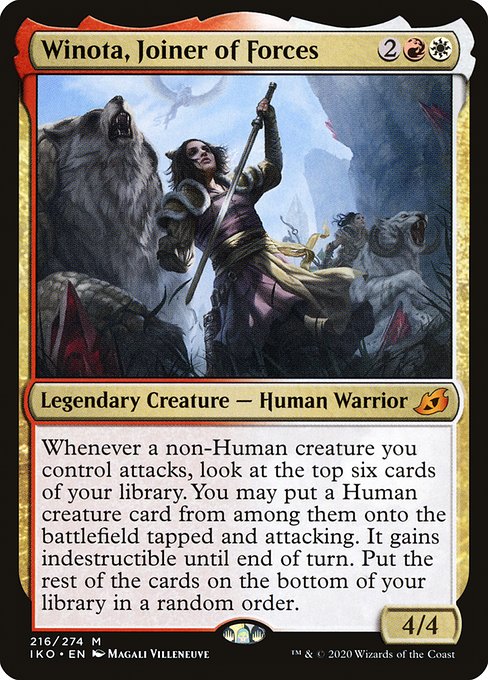
Example Commander: Winota, Joiner of Forces
Winota is one of the clearest examples of a commander whose gameplay and social profile are tightly connected. She appeals to players who love explosive combat, fast pressure, and powerful payoff turns. But she also tends to attract immediate attention. If you enjoy being the obvious threat, that can be thrilling. If you dislike becoming the table’s problem before your board is even fully established, Winota can feel worse than her raw power level suggests.
The question almost nobody asks: what frustrates you?
Sometimes the fastest way to find the right commander is not asking what excites you. It is asking what consistently drains your enjoyment. This is often more useful, because frustration reveals things that aspiration hides.
Maybe you hate long turns. Not just your opponents’ long turns, but your own. You thought a trigger-heavy engine deck would feel brilliant, but after a few games it starts to feel like paperwork. Maybe you hate losing your commander repeatedly. You like the romance of commander-centric deckbuilding, but not the reality of commander tax and constant interaction. Maybe you hate repetitive games. You thought consistency would feel reliable, but instead every game starts feeling like the same script. Maybe you hate being behind on board. You can appreciate slower decks in theory, but in practice you dislike spending the first few turns merely “preparing” while everyone else is already playing real Magic.
Maybe you hate bookkeeping. Tokens, treasures, counters, copied spells, delayed triggers, impulse draw windows, and graveyard loops all sound manageable individually, but together they make the deck feel more exhausting than rewarding. Maybe you hate being hated. The deck is powerful, but you are tired of being the first person everyone worries about.
Those frustrations are not side notes. They are central to choosing the right commander. A deck that repeatedly activates your least favorite part of the format is almost never the right long-term fit, even if it wins games.
Was this article useful?
Feedback helps improve future ManaForge guides.
Keep exploring