Commander Intermediate
Choosing the Commander That Truly Fits You
Why the right Commander is about more than archetypes, power, or popularity Commander is often called Magic’s most personal format, and for good reason. No other format asks you to make so many decisions about...
Commander Intermediate Page 5 of 6
In this article 14 sections
Replayability is the real test
A new deck can feel fantastic for the first few games simply because it is new. The synergies are fresh, the lines are exciting, and every interaction feels rewarding. But the real question is what happens after that. Does the commander still feel interesting on game twenty?
That is the real test. Some commanders are powerful but structurally repetitive. They funnel the game into the same patterns, the same priorities, and the same payoff turns. For players who love refinement and consistency, that is not necessarily a problem. For others, repetition slowly drains the attachment out of the deck.
Other commanders stay compelling because they leave room for improvisation. They support different kinds of games, different sequences, and different pivots depending on what you draw and how the table develops. They may not always be the most efficient version of an archetype, but they often remain more enjoyable because they keep asking slightly different questions.
One of the smartest things you can ask when choosing a commander is whether you want mastery through repetition or enjoyment through variation. Some players love a tighter deck that rewards learning the same lines more deeply. Others want a commander that keeps surprising them. Neither instinct is wrong, but they point toward very different long-term choices.
Power is only one kind of satisfaction
Many players chase power as if power automatically solves everything. It does not. Of course power matters. A deck that cannot keep up with your group will eventually feel frustrating. A commander that never gets enough time or space to function can leave you feeling helpless. But the wrong kind of power can make a deck feel worse rather than better.
A commander might be stronger, but also more linear. More efficient, but more repetitive. More feared, but more socially exhausting. More optimized, but less expressive. More likely to win, but less likely to feel like your deck. This is where many players accidentally optimize the soul out of a list. They solve problems they did not actually mind and create new ones they did not expect.
The real question is not whether a commander is powerful. It is whether its kind of power matches the kind of experience you want. Do you want explosiveness? Resilience? Precision? Political leverage? Scaling inevitability? Constant pressure? Different commanders offer different versions of strength, and not all of them feel good to the same player.
Your pod matters more than theory does
A commander that looks perfect in abstract can be completely wrong in your actual playgroup. This is where a lot of generic online advice falls apart. Commander is not played in theory. It is played in real pods, with real habits, real memory, real expectations, and real tolerance for certain play patterns.
If your group loves long grindy games full of wipes and interaction, an all-in glass-cannon commander may feel miserable. If your pod is fast and proactive, a slower setup engine may never get enough breathing room. If your table dislikes prison pieces, repetitive combo finishes, or heavy tutoring, certain commanders may create social friction even if they are technically fair. The same commander can feel playful in one pod, oppressive in another, underpowered in a third, and perfectly balanced in a fourth.
That means the best commander for you does not exist in a vacuum. It exists at the intersection of your own preferences and the environment you actually play in. A very useful question is this: do I like not only this commander, but also the version of this commander that exists in my group? That is often the difference between a deck you admire and a deck you genuinely keep sleeved.
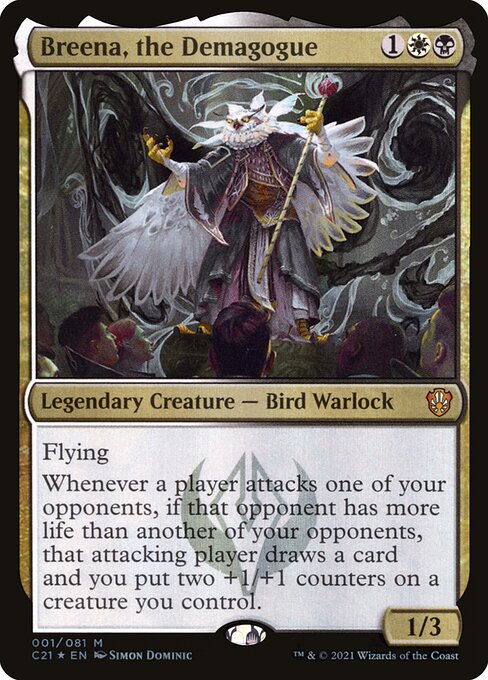
Example Commander: Breena, the Demagogue
Breena is a great example of a commander whose value changes dramatically with the pod. She appeals to players who enjoy politics, table awareness, subtle pressure, and leveraging opponents’ decisions rather than simply overpowering them. In the right group, that can feel interactive and brilliant. In the wrong group, where politics barely matter or the games are too blunt and fast, much of her unique appeal can disappear.
Was this article useful?
Feedback helps improve future ManaForge guides.
Keep exploring