
Source transparency: This Digest item is based primarily on reporting from MTGGoldfish. TMF summarizes and interprets the news; original reporting remains credited and linked.
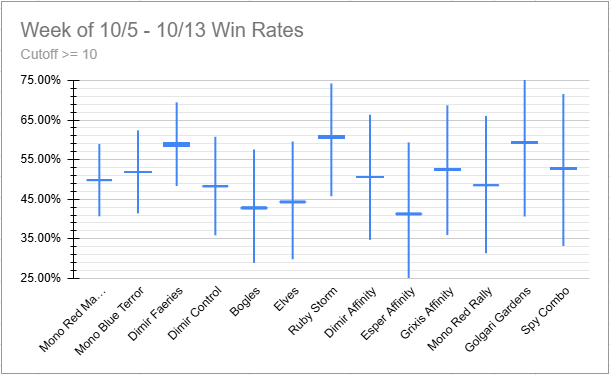
Pauper’s latest Magic Online results put Dimir Faeries among the strongest established choices in a shifting post-Zeta metagame. MTGGoldfish’s October 16 recap combines nine Challenges held October 5–13, totaling 406 event entries. Dimir Faeries accounts for 39 of those entries and a reported 59.3% non-mirror match win rate.
The result is supported by more than one isolated finish. In the 58-player October 11 Challenge, Dimir Faeries occupied four Top 8 places and both sides of the final. Purgatory_01 won at 8–1 with four Baleful Strix, four Spellstutter Sprite, four Ninja of the Deep Hours and two Thorn of the Black Rose. The finalist also ran four Strix, alongside a different mix of Ninjas and interaction.
Baleful Strix gives the shell a creature that replaces itself and discourages attacking, while Ninjas can reuse its enter-the-battlefield value. The evidence supports a successful Faeries configuration in this period; it does not isolate Strix’s causal contribution or prove that every Dimir control deck improved equally.
That distinction is visible in the broader numbers. Dimir Control has 29 entries but a 48.2% non-mirror win rate. Mono-Blue Terror records 40 entries and 52%, while Mono-Red Madness remains the most played archetype at 58 entries but sits at 49.8%. Popularity alone therefore tells a different story from performance. Bogles and Elves each contribute 20 entries, with 42.6% and 44.2% respectively, despite individual successful finishes elsewhere in the recap.
This is fresh evidence rather than a repeat of the previously reported two-week, 533-entry Zeta sample. The new report specifies its own October 5–13 event window and adds a later multi-event aggregate. Some dates overlap earlier reporting, so the samples should not be added together as independent populations.
There are further limits: event entries are not necessarily unique people, online Challenges are not the whole Pauper field, and the source’s plotted uncertainty ranges remain substantial. A 59.3% estimate is a preparation signal, not a guaranteed future win rate. The already-known October 12 decision to leave Pauper unchanged is background; the current development is how decks are performing while the format adapts.
The result is supported by more than one isolated finish. In the 58-player October 11 Challenge, Dimir Faeries occupied four Top 8 places and both sides of the final. Purgatory_01 won at 8–1 with four Baleful Strix, four Spellstutter Sprite, four Ninja of the Deep Hours and two Thorn of the Black Rose. The finalist also ran four Strix, alongside a different mix of Ninjas and interaction.
Baleful Strix gives the shell a creature that replaces itself and discourages attacking, while Ninjas can reuse its enter-the-battlefield value. The evidence supports a successful Faeries configuration in this period; it does not isolate Strix’s causal contribution or prove that every Dimir control deck improved equally.
That distinction is visible in the broader numbers. Dimir Control has 29 entries but a 48.2% non-mirror win rate. Mono-Blue Terror records 40 entries and 52%, while Mono-Red Madness remains the most played archetype at 58 entries but sits at 49.8%. Popularity alone therefore tells a different story from performance. Bogles and Elves each contribute 20 entries, with 42.6% and 44.2% respectively, despite individual successful finishes elsewhere in the recap.
This is fresh evidence rather than a repeat of the previously reported two-week, 533-entry Zeta sample. The new report specifies its own October 5–13 event window and adds a later multi-event aggregate. Some dates overlap earlier reporting, so the samples should not be added together as independent populations.
There are further limits: event entries are not necessarily unique people, online Challenges are not the whole Pauper field, and the source’s plotted uncertainty ranges remain substantial. A 59.3% estimate is a preparation signal, not a guaranteed future win rate. The already-known October 12 decision to leave Pauper unchanged is background; the current development is how decks are performing while the format adapts.
Original source: The Power of Pauper: The Zealots Keep Marching On! ↗MTGGoldfish