
Source transparency: This Digest item is based primarily on reporting from MTG Rocks. TMF summarizes and interprets the news; original reporting remains credited and linked.
The latest Alchemy: Reality Fracture previews show two distinct ways to build around Arena's digital cards: recurring sacrificed creatures and accelerating planeswalker loyalty. MTG Rocks' October 11 coverage includes complete preview images for The Bloodbile Swarm, Quintorius, Fate Splitter and Remnants of Beleren. Wizards' October 12 format update confirms the supplemental drop is due October 13. These are prospective constructions, not tournament-tested results or paper Commander additions.
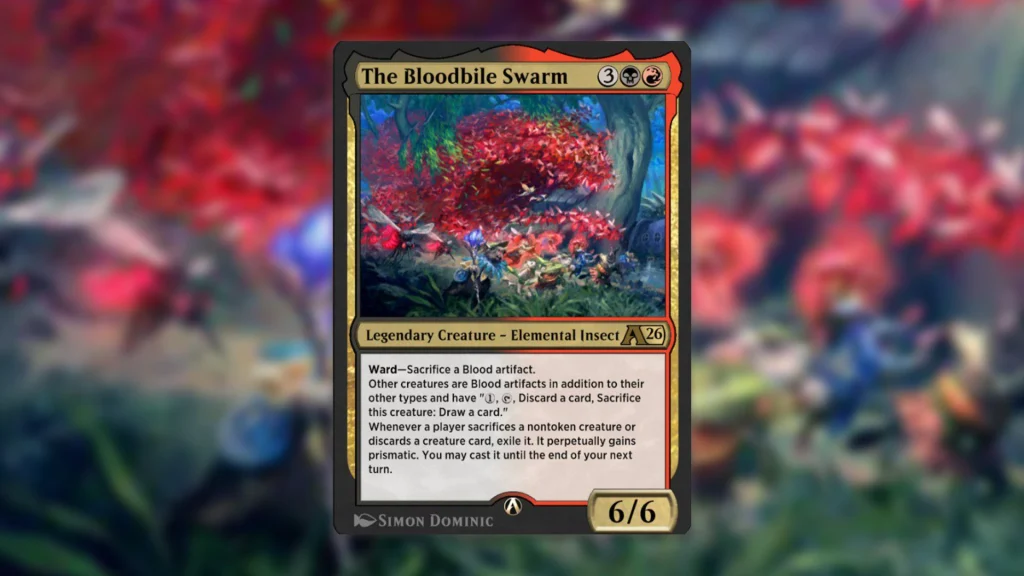
The Bloodbile Swarm is a five-mana black-red 6/6. Other creatures become Blood artifacts as well as retaining their existing types, and gain the familiar Blood activation: pay one mana, tap, discard a card and sacrifice that creature to draw. The tap requirement matters. A newly entered creature normally cannot immediately use this activation, so the ability does not make every fresh creature a ready-to-use rummage effect.
The more powerful engine is separate. Whenever any player sacrifices a nontoken creature or discards a creature card, the Swarm exiles it, gives it prismatic perpetually and lets you cast it until the end of your next turn. Recasting still costs mana, and tokens cannot supply this loop. The source did not establish prismatic's exact rules at preview time, so colored theft and recasting claims should wait for those rules.
A colorless zero-cost creature avoids that uncertainty. With Ornithopter and an appropriate free sacrifice outlet, sacrificing the nontoken Ornithopter produces an exile-and-recast cycle. Ashnod's Altar would generate two colorless mana on every repetition; Altar of Dementia would instead provide repeated mill activations. These lines require all pieces to remain available, the Swarm to survive and the supporting cards to be legal in the chosen Arena format. They are not evidence of an Alchemy deck that already wins consistently. A five-mana centerpiece also gives opponents time to establish interaction.
The loyalty previews solve different problems. Quintorius, Fate Splitter costs five mana and allows your planeswalkers' loyalty abilities to be activated twice during the turn it enters. Its zero ability proliferates and gains three life, so two activations can move an existing Superfriends board toward ultimates while providing a life cushion. The extra-activation permission expires with that turn; it is not a permanent doubling effect.
Remnants of Beleren is a two-mana blue artifact. Instead of an Empower Jace event, you may put that many loyalty counters on a Jace you control. Its tap ability empowers once, and a separate two-mana tap activation drafts from the Beleren Spellbook. Concentrating counters can accelerate a specific Jace, but it replaces the empowerment rather than providing both benefits, and random spellbook options are less reliable than a dedicated plan.
Together these previews reward carefully assembled boards. Removal, interrupted sacrifice chains, a lack of suitable targets and the cost of deploying the engine remain meaningful weaknesses.
The Bloodbile Swarm is a five-mana black-red 6/6. Other creatures become Blood artifacts as well as retaining their existing types, and gain the familiar Blood activation: pay one mana, tap, discard a card and sacrifice that creature to draw. The tap requirement matters. A newly entered creature normally cannot immediately use this activation, so the ability does not make every fresh creature a ready-to-use rummage effect.
The more powerful engine is separate. Whenever any player sacrifices a nontoken creature or discards a creature card, the Swarm exiles it, gives it prismatic perpetually and lets you cast it until the end of your next turn. Recasting still costs mana, and tokens cannot supply this loop. The source did not establish prismatic's exact rules at preview time, so colored theft and recasting claims should wait for those rules.
A colorless zero-cost creature avoids that uncertainty. With Ornithopter and an appropriate free sacrifice outlet, sacrificing the nontoken Ornithopter produces an exile-and-recast cycle. Ashnod's Altar would generate two colorless mana on every repetition; Altar of Dementia would instead provide repeated mill activations. These lines require all pieces to remain available, the Swarm to survive and the supporting cards to be legal in the chosen Arena format. They are not evidence of an Alchemy deck that already wins consistently. A five-mana centerpiece also gives opponents time to establish interaction.
The loyalty previews solve different problems. Quintorius, Fate Splitter costs five mana and allows your planeswalkers' loyalty abilities to be activated twice during the turn it enters. Its zero ability proliferates and gains three life, so two activations can move an existing Superfriends board toward ultimates while providing a life cushion. The extra-activation permission expires with that turn; it is not a permanent doubling effect.
Remnants of Beleren is a two-mana blue artifact. Instead of an Empower Jace event, you may put that many loyalty counters on a Jace you control. Its tap ability empowers once, and a separate two-mana tap activation drafts from the Beleren Spellbook. Concentrating counters can accelerate a specific Jace, but it replaces the empowerment rather than providing both benefits, and random spellbook options are less reliable than a dedicated plan.
Together these previews reward carefully assembled boards. Removal, interrupted sacrifice chains, a lack of suitable targets and the cost of deploying the engine remain meaningful weaknesses.
Original source: New Spoilers Showcase Infinite Combo Insect and Massive Superfriends Support ↗MTG Rocks